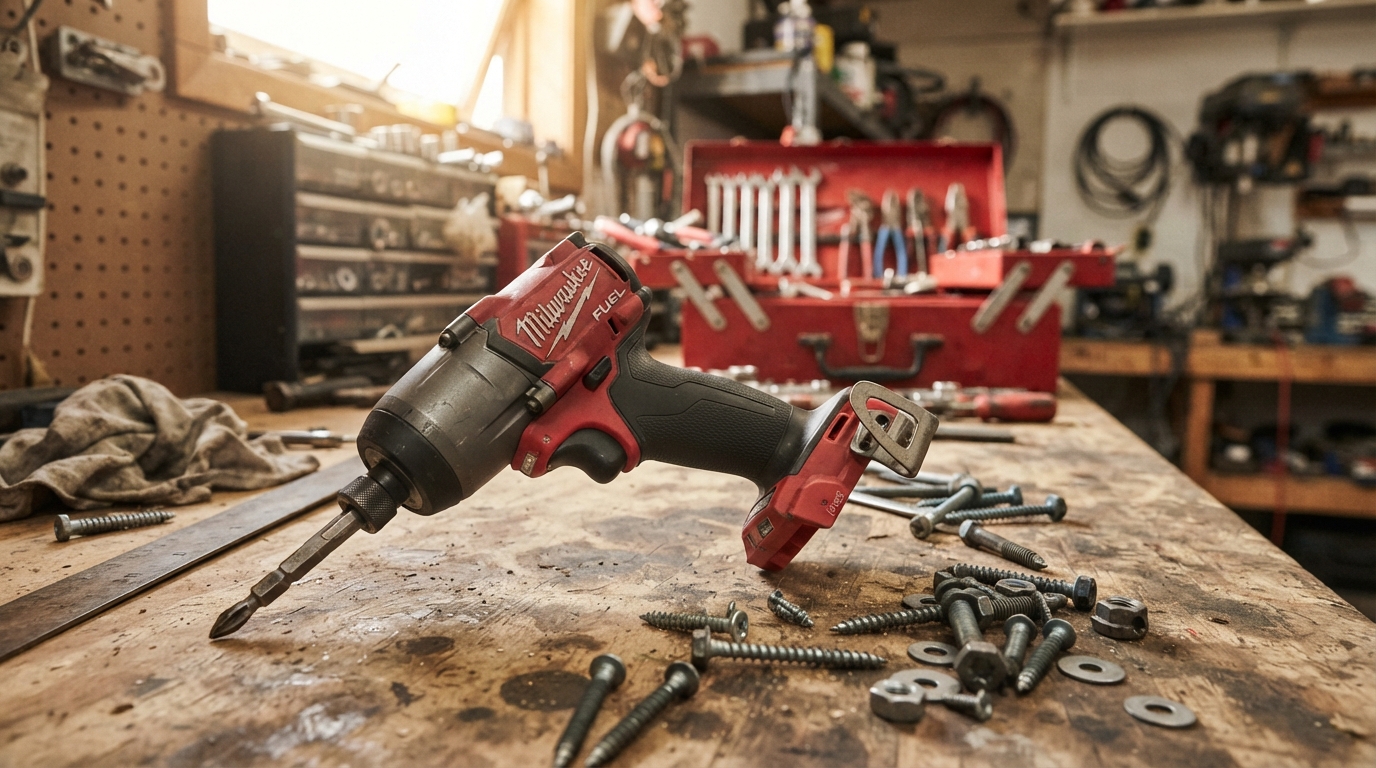
A stubborn screw can strip its head, or a standard bit can snap when a driver delivers a sudden torque burst. As of 2026, an “impact screwdriver” generally means an impact driver: a compact power tool for driving screws and smaller bolts, not a precision electric screwdriver for delicate electronics. An impact-rated bit is a screwdriver bit built to absorb the sudden torque pulses of an impact driver without snapping as readily.
According to “What Are Impact Screwdriver Bits?”, impact-rated bits transfer those forceful bursts to the fastener. Standard bits are more rigid and brittle, while impact bits often use more ductile steel and a torsion zone that flexes under shock. Using a regular bit under high load can cause cam-out, a stripped head, or a broken bit. Match the profile exactly: use Torx with Torx and Pozidriv with Pozidriv; forcing a Phillips bit into a Pozidriv screw is a common mistake. The next comparisons match strong tool choices to jobs rather than treating every electric screwdriver as an impact tool.
Key Takeaways
- An impact driver suits demanding screws and smaller bolts.
- Use impact-rated bits for sudden torque pulses.
- Match the bit profile and size to the fastener.
- A regular bit can cam out, strip, or snap under high load.
- The most powerful tool is not always best for confined or delicate work.
Best impact screwdriver 2026: Top picks for heavy-duty repairs
The DeWalt 20V Max XR impact driver is the strongest choice for demanding screws and nuts or bolts, while the Bosch Go 3 is the more controlled choice for repeated fastening. The DuroFort 8V cordless screwdriver is a lower-cost option for occasional DIY work, but the Bosch Go 3 and DuroFort are electric screwdrivers, not direct equivalents to the high-power DeWalt cordless impact driver.
DeWalt 20V Max XR impact driver for maximum power
Choose the DeWalt 20V Max XR when heavy-duty repairs call for substantial driving force and you want to stay within a 20V battery platform. According to “Best high-power electric screwdriver,” its three-speed brushless motor reaches a stated 1,825 inch-pounds of maximum torque, 3,250 rpm, and up to 190 Nm, with built-in LEDs. It handles screws and nuts or bolts well, though its larger body is less suitable for cramped spaces or delicate work.
Bosch Go 3 for controlled heavy-duty driving
Choose the Bosch Go 3 for repeated fastening where control matters more than maximum output. The same source lists USB-C charging, a 2.0Ah battery, a ring light, extra torque settings, 360 rpm rotation, and 2.5–5.0 Nm of electric torque. Bosch positions it for daily hard use, while its bulk and cost make it a poor fit for precision work. It is a controlled electric screwdriver, not a replacement for a high-torque impact driver.
DuroFort 8V cordless screwdriver for lower-cost DIY use
Choose the DuroFort 8V cordless screwdriver as an occasional-use or spare tool. According to “Best affordable screwdriver,” it offers a 10-speed gearbox, 5.5 Nm electric torque, 10 Nm manual torque, 320 rpm, an 89-bit selection, a nut adapter, and a flexible shaft. Its chunky body is awkward in confined spaces, and the source positions it below a daily professional tool. For impact-bit accessories, Milwaukee Shockwave, DeWalt FlexTorq, Makita Gold, and Bosch Impact Tough use features such as shock absorption and torsion zones. Verify every model version, specification, price, and 2026 availability in the current listing. Next, use the selection rules that prevent overbuying, battery mismatches, and damaged fasteners.
How to choose and use an impact screwdriver for heavy-duty repairs
Match torque, bit design and battery system to the job
Use a practical purchasing checklist: start with the fastener and repair, then work backward to torque, bit compatibility, and the battery platform. Confirm the bit has the common 1/4-inch hex shank, the exact profile and size, and a torsion zone that flexes slightly to dissipate peak force. According to “Material & Steel Grade,” S2 and CR-MO steel are high-grade choices for hardness and resistance to breakage. Black oxide and manganese phosphate can improve corrosion resistance, while titanium-related coatings may reduce friction and wear.
A precision-machined or forged tip improves contact and torque transfer, which reduces cam-out. Magnetic impact bits help retain fasteners overhead or in tight spaces; non-magnetic bits may be preferable around sensitive electronics. Match the battery to a system you already own when possible, since cordless tools otherwise require another battery and charger. A compatible platform can matter as much as a higher torque rating if you use the tool regularly.
Avoid stripped fasteners and over-tightened bolts
An impact driver is the compact choice for smaller screws and bolts, while an impact wrench generally delivers more torque for large automotive nuts. A 1/2-inch impact wrench is more appropriate for many lug-nut jobs, though a powerful impact driver may handle some nuts with the correct socket adapter. Do not use an impact driver to final-tighten a critical bolt without checking the manufacturer’s torque specification. As “Is there a risk of over-tightening bolts?” explains, excess force can strip threads or damage parts, so use the driver for initial tightening and a torque wrench for the specified final torque.
Choose the tool that meets the repair’s torque requirement without adding unnecessary size or force.
Choose the right impact screwdriver for the repair
Base the decision on job severity and control, not brand popularity. Select the DeWalt 20V Max XR for the heaviest screw-driving and nut-or-bolt work covered here, the Bosch Go 3 for controlled repeated fastening, and the DuroFort for occasional lower-cost use. Square or Robertson bits resist slipping in construction and woodworking, while Torx bits provide broad contact in automotive, electronics, and appliance work. The correct shape and size reduce stripping and premature wear.
Identify the largest and most delicate fastener in your planned repair. Buy the compatible impact-rated bit, then confirm the tool’s battery and torque requirements. Test the selected bit on a non-critical fastener before working on the repair, and use a torque wrench wherever the job calls for a specified final torque.