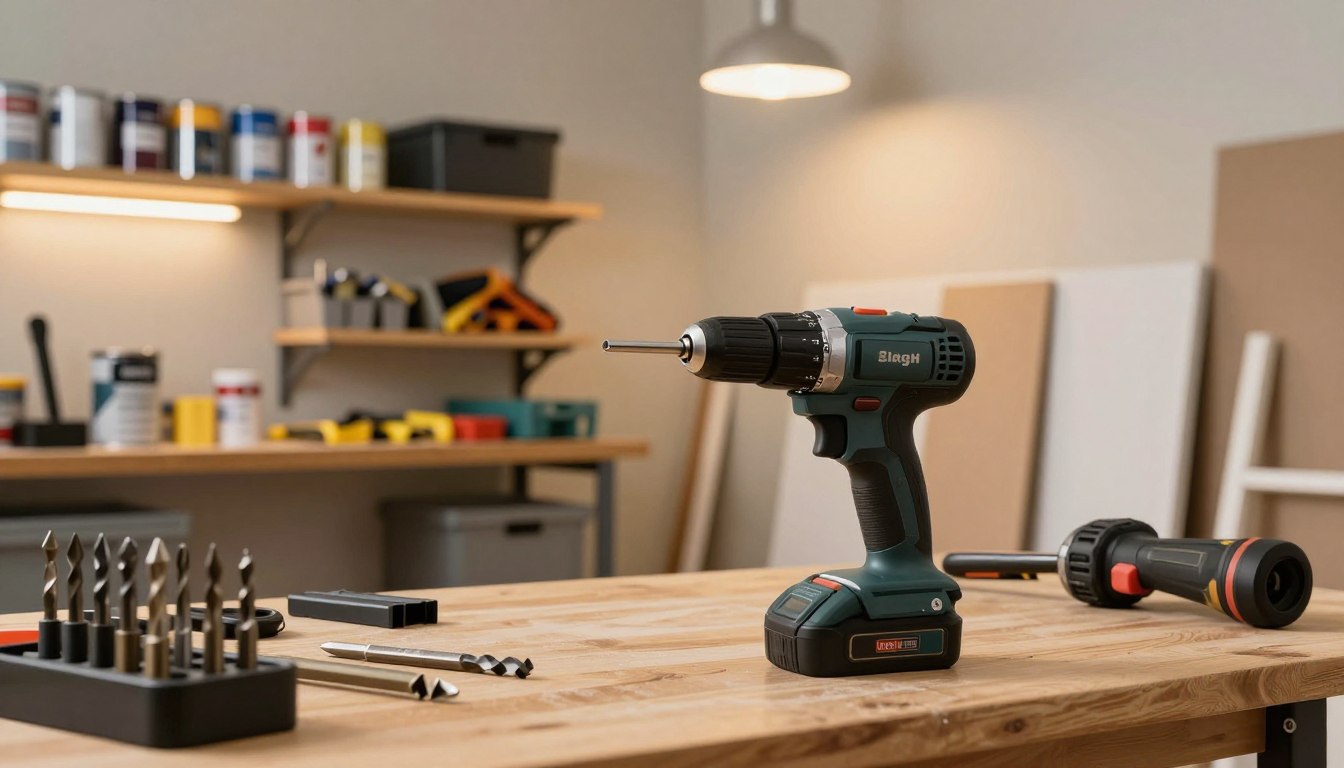
For most home repairs, a cordless drill set is the tool that handles both pilot holes and everyday screws. A cordless drill is a battery-powered handheld tool that rotates a chuck for drilling holes and driving fasteners.
A set may combine a drill driver, battery, charger, and bits, giving you a usable starting point instead of a bare tool. Light-duty models suit assembling flat-packed furniture, changing a light fixture, and drilling into drywall. General-use models handle tasks such as hanging shelves and tightening screws. The right choice depends on the material, hole size, fastening workload, reach, and battery platform you already own.
A heavier, high-power tool is not automatically better for occasional indoor work. Extra size can make a simple overhead repair tiring, while a lighter drill may give you better control. Choose a complete kit when you need the battery and charger as much as the drill. The practical path is to match your projects first, then compare motor, battery, kit contents, and purchase details.
Key Takeaways
- A drill driver set can cover both holes and everyday fastening.
- Light-duty tools suit furniture, fixtures, and drywall.
- General-use drills are useful for shelves and household repairs.
- Project material and hole size matter more than a large label.
- A complete kit can be more useful than a bare tool.
- A compact tool may be preferable for occasional indoor work.
How to Choose a Cordless Drill for Home Projects
Start with the hardest job you expect to do, not the biggest number printed on the box. A drill driver kit is a good fit when you need controlled drilling and fastening, but the right tool depends on how demanding that work will be and how long you will hold it.
- Project materials: List whether you will work in drywall, wood, metal, brick, block, or concrete. Materials determine whether a standard drill driver is enough or whether hammer action belongs on your list.
- Largest hole and longest fastener: Note the largest bit and longest screw you expect to use. A tool that handles small pilot holes may feel strained when boring through a thick stud or driving a long structural fastener.
- Expected hours of use: Occasional furniture assembly does not demand the same endurance as building a deck. Frequent work can justify a more efficient design and an extra battery.
- Acceptable tool weight: Include the battery when judging working weight. A drill that feels manageable at a store can become uncomfortable during repeated overhead work.
- Existing battery platform: If you already own compatible batteries, staying with that brand’s battery system can reduce duplicate chargers and packs. A new platform may make sense only when your current tools cannot handle the work.
A complete drill driver kit can be more practical than a bare tool because the charger and battery are ready for the first project. Check whether the package also includes useful bits rather than assuming that every box does. Do not choose voltage first and discover later that the body is uncomfortable for overhead work. Voltage is the first specification that narrows the field once these five checks are clear.
Match Voltage to Light, General, and Heavy-Duty Work
A 12-volt drill can be the smarter choice for a homeowner who values low weight over maximum force. Voltage is a workload guide, not a quality ranking: higher voltage generally brings more speed and torque, but it often adds weight and bulk.
Light-duty drill batteries range from 12 to 20 volts and suit small holes, furniture, fixtures, and drywall. General-use drills typically use about 12 volts and cover everyday household repairs. Heavy-duty drills generally use 18 to 20 volts or more; they can bore large holes through studs or joists and drive hundreds of screws on one battery charge. Lower-voltage drills can weigh as little as half as much as heavier-duty models.
| Work level | Typical voltage | Best-fit jobs | Trade-off |
|---|---|---|---|
| Light-duty | 12–20 volts | Furniture, fixtures, drywall | Less force for large holes |
| General-use | About 12 volts | Shelves, repairs, everyday screws | Limited for repeated heavy fastening |
| Heavy-duty | 18–20 volts or more | Studs, joists, decks, long screws | More weight and bulk |
“20V Max” labeling is a marketing convention; usable performance still depends on the motor and battery system. A high number does not make a tool automatically better for small work. Once voltage is matched to the workload, compare the different jobs handled by a standard drill driver and an impact driver.
Drill Driver or Impact Driver?
If you are buying one tool, choose the drill driver; add an impact driver when repeated heavy fastening is part of the job. A drill driver uses a chuck and adjustable clutch for drilling and controlled screw driving, while an impact driver uses impacting force and commonly accepts hex-shank bits.
The drill driver is generally the more versatile single-tool choice. Its chuck accepts drill bits for smooth holes, and its clutch helps you stop before a small screw sinks too far. An impact driver is useful for long screws, structural fasteners, and repeated fastening where extra driving force saves effort. The impact mechanism is louder, and its hex-bit format can make bit changes less flexible than a drill driver’s chuck.
An impact driver is not a replacement for a drill driver when smooth holes or precise clutch control matter. Using impact force on small cabinet screws can strip the fastener or damage the workpiece. For delicate screw driving, finished surfaces, and varied drilling, use the drill driver. For a long series of stubborn fasteners, an impact driver kit may be worthwhile.
Choose the tool according to the motion you need, not just the torque figure. That distinction leads to the next decision: whether hammer mode is useful for masonry work.
When a Hammer Drill Makes Sense
Choose a hammer drill when your project includes anchors in masonry rather than only wood, drywall, or metal. Hammer action adds an impacting movement to rotation, helping a masonry bit drill into denser materials such as brick, block, and concrete.
Hammer drills suit occasional holes for shelves, pictures, and other anchors. They do not turn a homeowner tool into a rotary hammer, which is the more appropriate choice for extensive concrete drilling or sustained demolition. Use masonry bits, and switch hammer action off for wood and metal. Do not use hammer mode for ordinary screws or finished wood.
Examples show why hole size and material matter. The Milwaukee M18 2904 hammer drill produced 1,400 inch-pounds of torque and reached 2,100 rpm; that model drilled 1/4-inch holes into concrete. The FLEX 24V model drilled 3/8-inch holes, the Makita 18V LXT model drilled 5/8-inch holes, and the Bosch 18V model drilled 1/2-inch holes into concrete.
- Masonry frequency: occasional anchors may justify hammer mode; frequent work may justify a rotary hammer.
- Hole diameter: match the tool’s demonstrated capacity to the anchor size.
- Dedicated tool need: choose a rotary hammer for extensive concrete or large masonry holes.
Hammer action is a specialized setting, not a reason to use impact on every task. With tool type established, attention can shift to brushless motors and how they affect everyday behavior.
Brushless Motors, Brushed Motors, and Everyday Value
Brushless is most useful when the drill will work hard or often, not simply because the label sounds more advanced. A brushless cordless drill uses an efficiency- and durability-oriented motor design that can be valuable during frequent drilling, dense-material work, and long sessions.
Brushless cordless models in this product range include the FLEX 24V Brushless Cordless Hammer Drill, Bosch 18V Brushless Hammer Drill/Driver, and RIDGID 18V Brushless 2-Tool Combo Kit. The FLEX model has a maximum speed of 2,500 rpm and 1,400 inch-pounds of torque. The Bosch model has 575 inch-pounds of torque.
A brushed tool can be a sensible value for occasional repairs because its lower purchase cost may matter more than maximum efficiency. A brushless motor can make more sense when you drill regularly, work in dense materials, or spend long periods fastening. The label does not promise a fixed runtime or lifespan, and it does not guarantee the lightest body or strongest performance. Compare the complete tool, controls, battery system, and workload instead of paying for the word “brushless” alone.
The useful question is how often the motor will work hard. That answer leads directly to the battery and charger decisions that determine how long a cordless tool stays useful.
Batteries and Chargers for a Complete Set
The battery is part of the working weight, so a bigger pack is not automatically the better choice. Amp-hours indicate expected runtime, not a direct measure of tool power; a compact battery can be easier overhead, while a higher-capacity battery can help during long fastening sessions.
A drill battery can add about 0.5 to 1.5 pounds to the tool’s overall weight, depending on capacity. The Ryobi hammer drill’s performance was measured with a high-performance 18-volt battery rather than its standard 2Ah battery. The Makita XPH14 kit includes a 5.0Ah battery, and the FLEX 24V tool is described with an included 5.0Ah battery.
| Battery type | Best use | Weight effect | Charging need |
|---|---|---|---|
| Compact battery | Overhead work and short repairs | About 0.5 pound added | Useful for short jobs |
| Standard battery | Routine household drilling | About 0.5–1.5 pounds added | One pack may suit occasional work |
| High-capacity battery | Long fastening sessions | About 1.5 pounds added | 5.0Ah packs may need longer charging |
Two batteries can keep work moving while one pack charges, though the extra pack adds cost and storage needs. A battery and charger from one brand platform may not fit another. Buy the charger designed for the same platform, voltage system, and battery type. Stored battery power becomes useful control through the drill’s speed, torque, clutch, and chuck features.
Speed, Torque, Clutch Settings, and Chuck Design
A drill with more power becomes easier to use when its controls let you dial that power back. Torque is twisting force, rpm is chuck speed, and the clutch limits fastening force so a screw is less likely to sink too deeply or strip.
Two- and three-speed selectors let you choose a slower range for torque-heavy driving or a faster range for drilling. A keyless chuck makes bit changes faster because you tighten it by hand rather than using a chuck key. The listed cordless drills range from 265 inch-pounds for the Bosch 12V Pocket Driver to 1,400 inch-pounds for the Milwaukee M18 2904 and FLEX 24V models. Listed maximum speeds range from 1,300 rpm for the Bosch 12V Pocket Driver to 2,500 rpm for the FLEX 24V model.
- Clutch range: look for enough settings to control small screws and larger fasteners.
- Speed selector: check for two or three useful speed ranges.
- Trigger response: choose a trigger that starts smoothly at low speed.
- Chuck grip: confirm that the keyless chuck holds the bits you plan to use.
Head lengths in the listed models range from 5.5 to 8 inches, which can affect access in cabinetry and between studs. Maximum speed and torque are not the right settings for every screw. Physical comfort, reach, and handling determine whether those controls remain useful during real work.
Size, Weight, Grip, and Reach
A drill that fits between cabinet sides can save more time than one with an extra increment of torque. Compact drills are easier to position in tight spaces and overhead, while larger bodies can provide stability during demanding drilling.
Bare-tool weight excludes the battery, so working weight is higher. The Bosch 12V Max Two-Speed Pocket Driver weighs 1.8 pounds without the battery and has a 5.5-inch head length. The Skil PWRCORE Drill Driver weighs 2.23 pounds bare and has a 6.1-inch head length. The Milwaukee M18 2904 weighs 3.3 pounds bare and is just under 7 inches long.
The FLEX 24V tool weighs 3.9 pounds without the battery and has a 7.1-inch head length. The Makita XPH14 weighs 5.5 pounds without the battery and has a 7-inch head length. Grip shape, balance, and LED placement affect how those numbers feel. A shorter head can reach between studs or inside cabinetry, while a balanced handle can reduce wrist strain.
A heavier tool may be preferable for long, large-hole drilling if you can control it safely. A compact drill does not compensate for an unsuitable bit or battery. Judge the tool in its working configuration, with the battery attached and the bit installed. Those physical traits connect directly to furniture, fixtures, shelves, cabinetry, decks, and masonry work.
Match the Set to Your Project List
The best set for hanging shelves is usually not the same set you would choose to build a deck. Match the tool to the number of holes, the fastener length, the material, and the amount of time you will spend holding the drill.
- Furniture and fixtures: A light drill driver with a clutch is enough for assembling furniture, changing a light fixture, drilling drywall, and driving small screws. A complete set is enough when the kit includes a compatible battery, charger, and basic bits.
- Shelves and household repairs: Choose a general-use drill driver with a comfortable grip and a useful clutch for pilot holes and shelf hardware. A complete set works well when the jobs stay within wood, drywall, and light metal.
- Cabinetry and tight spaces: A cordless compact body, short head, responsive trigger, and good LED placement help inside cabinets. A complete set is enough when reach matters more than large-hole capacity.
- Decks and repeated fastening: Choose a higher-capacity battery and a tool suited to driving three-inch wood screws repeatedly. A drill-and-impact combo can be useful when drilling pilot holes and driving fasteners are separate, recurring tasks.
- Masonry anchors: Choose a hammer drill with masonry bits for occasional holes in concrete, brick, or block. A complete set is enough for modest anchor work, but extensive concrete work or very large structural holes may require a rotary hammer instead of a drill.
Wood work may involve spade and twist bits, while studs and joists demand more capacity than drywall. The next step is a factual comparison of representative kits and tools with different combinations of power, size, and included equipment.
Representative Drill Sets and Tool Options
The useful comparison is not one winner but which listed combination of power, size, and included equipment fits your work. A compact driver, a hammer drill, and a combo kit serve different priorities even when their specifications overlap.
| Tool or kit | Speed | Torque | Weight or distinctive feature | Best fit |
|---|---|---|---|---|
| Milwaukee M18 2904 | 2,100 rpm | 1,400 in-lb | 3.3 lb bare; three speeds; auto-stop | High power |
| Skil PWRCORE | 1,800 rpm | 400 in-lb | 2.23 lb tool-only; 6.1-inch head | General household work |
| Ryobi 18V One+ | 2,100 rpm listed; 2,150 rpm newer specification | 750 in-lb listed; 850 in-lb newer specification | Compact hammer drill | Masonry and general work |
| DeWalt 20V Max XR | Three speed options | Not stated | 4.1 lb bare; hammer drill | Heavy-duty drilling |
| Bosch 18V | Not stated | 575 in-lb | 2.5 lb bare; brushless hammer drill/driver | Light high-performance use |
| RIDGID 18V combo | Drill driver: 2,000 rpm | Drill driver: 1,250 in-lb | Two tools, two high-capacity batteries, charger; drill 2.5 lb bare | Combo |
| Bosch 12V Pocket Driver | 1,300 rpm | 265 in-lb | 1.8 lb tool-only; 5.5-inch head | Compact |
| Skil PWRCORE Flip | 1,700 rpm | 350 in-lb | 2.06 lb; two 1/4-inch collets; nine torque settings | Pilot-hole switching |
The Ryobi figures are shown separately because the listed specification gives 2,100 rpm and 750 inch-pounds, while a newer specification is described as 2,150 rpm and 850 inch-pounds. The RIDGID package stands out as an impact driver kit and drill driver combination, while the Skil PWRCORE Flip uses two 1/4-inch collets for quick pilot-hole switching. Use the distinctive feature that matches your project instead of treating every number as a ranking.
Before checkout, inspect the kit contents, included accessories, battery count, charger, and storage solution.
What a Cordless Drill Set Should Include
A low sticker price may describe only the tool body, not the battery and charger needed to use it. A usable drill kit should include the tool, a compatible battery, and a charger unless you already own that battery platform.
A bare tool is only the drill body. A drill kit usually adds one battery and a charger. A drill-and-impact combo adds an impact driver, and some packages include two batteries. Bits, a belt hook, a side handle, and a case vary by package. The RIDGID 18V Brushless 2-Tool Combo Kit includes an impact driver and two high-capacity batteries. The Skil PWRCORE Flip Drill has two 1/4-inch collets on a rotating chuck and a magnet for holding a screw. The Bosch 12V Pocket Driver Kit includes two speed options and multiple torque settings.
- Tool: confirm that the box contains the drill driver you need.
- Compatible battery: check the brand’s battery system and included capacity.
- Charger: confirm that a matching battery charger is included.
- Basic bits: look for drill bits suited to your common materials.
- Fastening bits: check for driver bits that match your screws.
- Storage or carrying solution: confirm a case, bag, or other way to keep parts together.
A premium cordless drill kit is described as costing $300 or more, while the Skil 20-volt drill kit is listed at $80. Do not buy a bare tool for a battery platform your household does not own. Once the box contents are clear, safe use and basic care protect the value of the set.
Safe Use and Basic Care
If a bit catches, the drill body can twist before the motor stops, so grip and setup matter. Secure the workpiece, use the correct bit, and keep both hands ready when a large bit or dense material can create high torque.
- Secure the workpiece before drilling or fastening.
- Use the correct bit for the material and fastener.
- Keep both hands ready for high-torque work.
- Remove the battery before changing bits or other parts.
- Stop when the bit binds instead of forcing the tool.
Auto-stop or anti-rotation features can shut off a drill when a bound bit causes excessive rotation. The Milwaukee, FLEX, DeWalt, Makita, Bosch, and RIDGID models described here include an auto-stop, rotation-protection, or kickback-control feature. Electronic protection reduces risk but does not replace bracing, eye protection, or correct technique. A drill battery can add 0.5 to 1.5 pounds, so hold the tool firmly rather than gripping it loosely while using a large bit.
Clear debris from the chuck, inspect bits for damage, store batteries appropriately, and keep charger contacts clean. These small habits help the tool remain predictable. Final purchase checks should cover the kit contents, price, availability, return terms, and what can or cannot be promised about delivery.
Buying Online: Price, Availability, and Shipping Checks
Before you click Buy, confirm that the price covers the equipment you need and not just the tool body. Listed examples include $279 for the FLEX 24V Brushless Cordless Hammer Drill, $349 for the RIDGID 18V Brushless 2-Tool Combo Kit, and $99 for the Skil PWRCORE Flip Drill.
The Skil 20-volt drill kit is listed at $80, and the premium cordless drill kits described here are listed as costing $300 or more. These prices are examples rather than permanent guarantees. Online product availability, shipping cost, delivery date, return rules, included batteries, and charger contents can vary by retailer and are not established by product details alone.
- Current price: identify the exact package and its listed cost.
- In-stock status: confirm that the product is available to order.
- Shipping cost and date: check both the charge and the stated delivery date.
- Return policy: read the conditions before placing the order.
- Battery count: confirm whether the package has zero, one, or two batteries.
- Charger inclusion: make sure the battery charger is in the box.
Do not compare an inexpensive bare tool with a complete premium kit as if they were equal packages. A displayed price may cover only the tool body, while another listing includes batteries, a charger, an impact driver, and a case. Choose the smallest complete set that safely handles your hardest recurring task, then confirm the final kit details at checkout.
Choose the Set That Fits Your Next Projects
For most homeowners, the right purchase is the lightest complete set that covers the hardest job they actually expect to do. A compact 12V-class set can suit light indoor repairs, while a higher-voltage hammer-drill or combo set makes more sense for dense materials or repeated fastening.
Write down the largest hole, longest fastener, and number of batteries you need. Filter the category by those requirements, choose a compatible battery platform, and verify the kit contents before checkout.